Ramblings

On Software Engineering

Spring

Writing from the patio on a much deserved day off. What a day, sunny and 68 this 3rd day of spring. It sometimes makes it real hard to work inside in a windowless box. It’s been a busy day of a different sort, but dang I could get used to it.

Software Engineering Is Consuming

Software Engineering can and is absolutely consuming work.  The short of it is, we like what we do so we tend to focus a lot of attention on it.  We are problem solvers, designers, learners, and the list goes on.  I am of the philosophy that you should find and do something you like because anything else is a waste.  I guess that philosophy has its pros and its cons.  Is it so bad when your day consists of writing code, solving problems, researching, and learning new things?

Achieving Balance

I guess everyone talks about work/life balance and its true; you must always take time for yourself.  Get outside, do some walking.  It will help clear your head and it is a good stress reliever.  Maybe you’ll come back to the task with some fresh ideas and renewed vigor.  The schedule will always be there.

Personally as of April, I will have been on a diet and exercise plan for 2 years.  I’ve lost a lot and still need to lose more.  One of my biggest problems has been shorting myself on time to maintain my walking and weight lifting.  I seem to always get wrapped up in something.

Having a rewarding hobby is probably a good idea.  I’m not talking about coding a side project (don’t we all seem to have an overabundance of those), I’m talking about something else entirely.  My non-programming hobby is photography.  I don’t get to do it much it seems anymore it seems, but I do find winter a dreary time to take photos.  I did have a major accomplishment in this area last fall.  I officially photographed a wedding.  While I was originally scared to take on such a task, the photos turned out wonderfully.  I took the photo below today.

2015_03_23_Spring_Bradford_Pear

Bradford Pear Blooming Spring 2015


Posted by Chad Dotson in Hobbies, Key Concepts, Photography, Programming, Ramblings, Software Engineering, 0 comments

The Flood of Social Media Posts – Whats Wrong, How To Mitigate It, How To Fix It

What’s Wrong

Since its creation, social media has taken off at an exponential rate.  Each day more and more people are creating accounts and contributing to the feed.  Facebook is the service most readily adopted, mainly because of the people already on it.  In the case of Facebook, lets say that the typical user has 200-300 friends and lets say that just a quarter of those (50 of 200) are enthusiastic posters (2-3 posts/day).  That equates to somewhere north of at least 100 posts per day then add to that the posts from your other friends.  Lets make a guess of an overall total of 200 posts/day on just that one social media outlet.  Facebook’s solution to the inundation of posts is the top posts vs recent posts feature.

Skip to the services that I think are the most susceptible to inundating users with content: Twitter and Pinterest.  As a user of Twitter, it seems that I have trouble following over 40 people.  Once upon a time I followed near 90 people and found that useful posts actually got buried in the noise.  Pinterest on the other hand seems to violate all that is good with respect to UI design; it is way to busy and your eyes don’t follow any particular lines.  Liberal use of pinterest’s follow feature can unintentionally muddy the content you see.

Tips On Dealing With It

I think the only way to fix usage of Twitter is to limit the number of people you follow.  Pick high quality, low post rate users.  This will improve the overall quality of content you get.  For Pinterest, limit the number of users or boards you follow.

How To Fix It

How do you fix being inundated with content?  Facebook is certainly trying to fix it via their “Top Posts” feature.  The top posts feature attempts to make guesses about what you want to see based on your interests, what you’ve looked at in the past, and probably other metrics (and controversial stuff such as a recent study).  Even though I don’t care for their current top posts feature I believe Facebook is on the right track.  It all boils down to the ability to listen to everything but only pay attention to what your interested in, even when you may not 100% know yourself.

I think the ultimate “Top Posts” algorithm would take into account the following:

  • What you’ve looked at in the past. (Given)
  • Users would be given preferred tags based on what they view.
  • It would tag each post and each would receive an initial ranking based on the types of posts the user normally make.
  • The initial ranking score given to a user’s posts is a function of how well their posts have done in the past.
  • Each post’s rank is updated in each of its tags as people view them based on their rank in the tag category.

Up Next: I may decide to make a post discussing a theory of how people leave one service and adopt another.

Posted by Chad Dotson in Misc, Ramblings, Tips, 0 comments

Apple’s Magic Mouse – A Software Engineer’s Perspective

Over the past month I’ve been trying to make the transition from my old windows environment to an OSX environment.  Part of the transition involved buying a Magic Mouse.  Apple’s Magic Mouse is definitely a very interesting device.  It is a very accurate mouse with the added capability of a gesture enabled touchpad.  While I like it, the negatives are over powering the positives… at least for me.

  • It seems too small, at least for my hand.
  • While you can scroll by using the integrated trackpad, there is no out of the box concept of a middle click.  I don’t use that when coding, but I sure use it alot when browsing the web.  I was able to get it back by installing the 3rd party tool “BetterTouchTool.”
  • The integrated trackpad is over half of the device.  I find that I mistakenly activate it alot.
  • The single action of the device whether right or left clicking is irritating.  Maybe its just the size of the device that makes this seem irritating.

While I think it maybe great for some people, I’m not sure they are great for everyone.  While I am not going to get rid of mine, I am starting to use my old Microsoft Mouse more often again.  About the only thing I miss about the Magic Mouse is the trackpad scrolling.

Posted by Chad Dotson in Ramblings, Technology, 0 comments
The Early Days of Flight

The Early Days of Flight

This post started from a comment I made on facebook about the “Volocopter” story on CNN.  At the time my comment was “Why does this look like something from the early days of flight?”  That it turns out is a very good question and an even better follow-up, “Aren’t we in the early days of [motorized, human] flight?”About 50,000 years ago, humans reached what is called behavioral modernity[1], “the point at which Homo sapiens began to demonstrate an ability to use complex symbolic thought and express cultural creativity”[2].  I think that is the reference point I will use for this post.  Am I leaving something out?  You bet, a heck of a lot in fact.  Another reference point I considered using was the control of fire by homo-erectus 400,000 years ago[3].  I ultimately decided on using the data of behavioral modernity because even after tens of thousands of years separating, those humans are us both anatomically and behaviorally.  We’ll use this timeline of “modern humanity” throughout this post.

So back to the topic of the post:  “Aren’t we in the early days of [motorized, human] flight?”  I believe the answer is a very resounding “yes.”  If we think about history of boat/shipbuilding, I believe can get a feeling for how new it is.

Let us compare two examples of what humans have created at the endpoint’s of “modern humanity.”  At between 9,523 and 10,053 years old the Pesse Canoe is thought to be the world’s oldest boat[3].  The Pesse Canoe is a simple, dugout canoe discovered in the Netherlands.  Fast-forward approximately 10,000 years to the USS Gerald R. Ford (CVN-78) slated to launch in 2015[4] which will be the most advanced ship built by human-kind at the time of its launch.  We, all to often find ourselves bounded by the technological achievements since the beginning of the space race, but that’s 10,000 years of well-earned technological achievements.  I’m sure that somewhere here there is a Moore’s Law of human ability (I say ability because I don’t feel intelligence nor ingenuity to be the right word).  That ability is based on what knowledge we have gained up to that point in time.
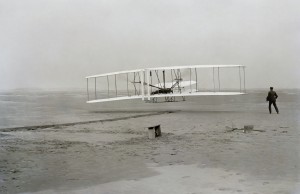
First Flight on December 17, 1903

First Flight on December 17, 1903

So now that we’ve talked human technological advances in boat/ship building, let us think about what brought us here, human flight.  Rudimentary usage of the science (understood or not) behind flight have been understood for anywhere between 2,000 and 2,500 years[6] but it wasn’t until Leonardo da Vinci’s drawings in the late 1400’s that humanity really started showing an understanding of the concepts behind flight.  For the most part, Leonardo’s best flight related discoveries were because he studied and tried to copy nature.  While successful attempts in winged human flight have been made as far back as the first millennium AD, it was 1903 when the Wright Brothers (credited) finally achieved winged, motorized flight.  In the 110 years since we have constructed advanced aircraft such as the Airbus A380.

As it turns out, there are a lot of significant inventions marking the timeline of human creations.  So much so I believe it is necessary to add “when a technology becomes useful” as a simplifying assumption to my statement.  Under that premise, our current capability in shipbuilding is based on 10,000 years of progressive technological advances and while our current capability in motorized flight is based on the culmination of thousands of years of technological advancement, its only been 110 years since we put it all together.  So, the answer is yes, we are in the early days of motorized, human flight.

Disclaimer: I am a computer scientist not a writer or history scholar.  This post is a collection of what I believe and what I’ve put together from the internet.

References:

  1. “Behavioral modernity.” Wikipedia: The Free Encyclopedia. Wikimedia Foundation, Inc., date last updated (8 November 2013). Web. Date accessed (27 November 2013). http://en.wikipedia.org/wiki/Behavioral_modernity
  2. “Human.” Wikipedia: The Free Encyclopedia. Wikimedia Foundation, Inc., date last updated (26 November 2013). Web. Date accessed (27 November 2013). http://en.wikipedia.org/wiki/Human
  3. “Control of fire by early humans.” Wikipedia: The Free Encyclopedia. Wikimedia Foundation, Inc., date last updated (24 November 2013). Web. Date accessed (27 November 2013). http://en.wikipedia.org/wiki/Control_of_fire_by_early_humans
  4. “Pesse canoe.” Wikipedia: The Free Encyclopedia. Wikimedia Foundation, Inc., date last updated (27 February 2013). Web. Date accessed (27 November 2013). http://en.wikipedia.org/wiki/Pesse_canoe
  5. “USS Gerald R. Ford (CVN-78).” Wikipedia: The Free Encyclopedia. Wikimedia Foundation, Inc., date last updated (22 February 2013). Web. Date accessed (27 November 2013). http://en.wikipedia.org/wiki/USS_Gerald_R._Ford_%28CVN-78%29
  6. “History of aviation.” Wikipedia: The Free Encyclopedia. Wikimedia Foundation, Inc., date last updated (24 February 2013). Web. Date accessed (27 November 2013). http://en.wikipedia.org/wiki/History_of_aviation
  7. “Early flying machines.” Wikipedia: The Free Encyclopedia. Wikimedia Foundation, Inc., date last updated (27 February 2013). Web. Date accessed (27 November 2013). http://en.wikipedia.org/wiki/Early_flying_machines



Posted by Chad Dotson in Misc, Ramblings, Technology, 0 comments
The Final Apollo Mission – December 7, 1972

The Final Apollo Mission – December 7, 1972

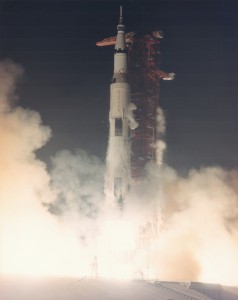
Apollo 17 Liftoff - December 7, 1942

Apollo 17 Liftoff – December 7, 1942

On December 7, 1972 (41 years ago today) the final manned mission to the moon blasted off from Kennedy Space Center.  Eugene Cernan was the last person to walk on the moon on December 14, 1972 at roughly 05:40 GMT. It is ultimately hard to believe that its been 41 years and we’ve not had a manned mission to Mars yet.  Even more astounding is the fact is that at this time we are between the Space Shuttle and its replacement, so we have no currently operational mode of launching humans into space.  The Orion capsule is currently under development and approaching ETF-1 (Exploration Flight Test-1), but that is scheduled for late 2014.

I got interested in the total time spent on the surface (just EVA’s for the Apollo missions) of of the Moon, you can find the figures on the table below.  You can tell by the figures when the Apollo missions started using the lunar rover.  I’ve also included drive distance of NASA’s Mars rovers.

Mission Surface EVA Surface Distance Covered
Apollo 11 2:31:40 Negligible
Apollo 12 7:45:18 2.0 km (1.2 mi)
Apollo 14 9:22:31 3.3 km (2.1 mi)
Apollo 15 19:07:53 27.9 km (17.3 mi)
Apollo 16 20:14:14 26.7 km (16.6 mi)
Apollo 17 22:03:57 35.74 km (22.21 mi)
Sojourner – 100 m (330 ft)
Spirit – 7.73 km (4.8 mi)
Opportunity – 38.70 km (24.05 mi) – Ongoing
Curiosity – 1 km (0.6 mi)+ – Ongoing

I leave you with this entry in the Sagan Series titled the “Gift of Apollo.”


References:


Posted by Chad Dotson in Misc, Ramblings, Technology, 0 comments

A Ride in a U-2

I found this video tonight.  Its a very stunning video of a ride that Top Gear’s James May took in a U-2.  Its really worth watching.

Posted by Chad Dotson in Misc, Ramblings, 0 comments

So much for that…

So…  what are we going to do if the F-22 falls through? Check out this video, I find the numbers they present to be a bit unbelievable.

Posted by Chad Dotson in Ramblings, Technology, 0 comments