I spent some time over the past year tinkering with Arduinos and Raspberry Pis and had a bit of a realization: Hardware circuit components are simply the syntax for creating physical devices. As a software person, putting hardware into that context has really given it a lot of meaning.
Chad Dotson
Automating Pylint with Gulp.js
Automating Pylint (and other Python Tasks) can be achieved with several viable python-based methods, but what if we used Gulp.js? The following code snippet gathers runs Pylint on the set of python files defined by pySource.
var gulp = require('gulp'),
shell = require('gulp-shell');
gulp.task("pylint", function() {
log('Linting with pylint -> creating report file.');
var files = [];
gulp.src(pySource, {read: true})
.on('data', function(file) {
files.push(file.path);
})
.on('data', function() {
shell.task(['pylint ' + files.join(' ') + ' -f parseable > pylint_report.txt'], {quiet: true, ignoreErrors: true})();
});
});
Notes:
- This is just a first cut. I may find a better way.
- I am aware that I could have simply used gulp-shell to call pylint with a collection of directories.
- I am open to feedback on this. Let me know if I’m doing something wrong or inefficient.
Node.js vs Python vs PyPy – A Simple Performance Comparison – Updated


Some History
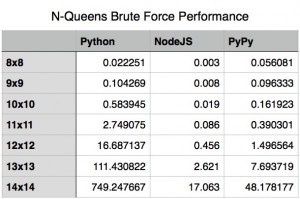
This is a followup to my original post: Node.js vs Python vs PyPy – A Simple Performance Comparison. This article corrects a discrepancy caused by a slight difference in the JavaScript implementation which skewed the Node.js results.
The Algorithm
As stated in the previous article, I’ve attempted to implement the same single-thread, brute force, recursive algorithm in many different languages. There is nothing overly special about this algorithm and I’ve made no attempts to optimize it.
The Findings
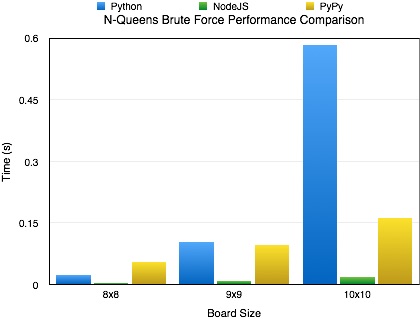
Node is fast, very fast. It easily outperforms any of the other implementations I’ve included in the puzzle’s repository. As you can see by the included charts, the performance difference between Node.js and out-of-the-box Python is very significant and the difference between it and PyPy while less pronounced is significant.
Special Notes
- I’ve placed my source on GitHub at the following url: https://github.com/chaddotson/puzzles. It now contains functional N-Queens puzzle implementations in JavaScript, Python, Lua, Scala, and Ruby. There is also a version in Rust, but that needs to be updated to the latest syntax before it can be run again.
- This is just with one type of algorithm, the best solution might and probably does change depending on what type of application you are researching. For webserver performance, Node.js is slightly better than PyPy running Tornado.
- This algorithm is a simple brute force algorithm, there are many faster and better ones out there.
- See the original article for the Node.js vs Python vs PyPy – A Simple Performance Comparison for more details memory performance.
Notes On Writing Testable JavaScript Vol 1
When writing JavaScript, I am a big fan of minimizing functionality and variables exposed publicly, which we all know to be good practice. However, this leads to anonymous functions and functions hidden within closures. So….
How Do You Test That?
How exactly do you test private methods in JavaScript? To answer that you should ask yourself, should I even be testing them independently or can I write tests for the exposed functionality and still achieve code coverage? If the answer to that question is “yes,” write tests for the exposed functionality that inherently test the underlying private functions and stop there. If the answer is “no, I really need to test this function.” There are a few approaches.
Member Variables For Testing Only
This approach involves creating member variables intended for testing and testing alone. This method relies on the build process to remove the variables before going to production. While this process works, I believe it has a code smell to it. You are polluting and bloating the code base with needless variables. If you are interested in the approach, here is an article about it.
The Real Question: Should It Be There?
Is the fact that you are asking this question an indicator of a code design issue? Perhaps the code is in violation of the Single Responsibility Principle? I’ve recently experienced a little epiphany associated with this. I realized that a collection of private functions that I was hiding actually belonged to a separate object as public functions. This refactoring drastically reduced the code complexity, made it more maintainable, and enabled small, important functions to be separately tested.
Make It Easy
Building a successful product is usually complicated business. With any luck a project will have an automated deployment process. This however is only part of the equation. Another significant part would be an automated build process.
Long Term Success
Long term success means making it easy for new people to get started in the weeks/months/years following a project’s startup. Imagine the following project in two different scenarios.
The project is a large scale application with several dependencies.
Scenario 1 (No automated configuration and build process):
- Check out project from source control.
- Perform configuration needed for dependencies.
- Build / Install each dependency separately.
- Perform configuration needed for product build.
- Build product.
Scenario 2:
- Check out project from source control.
- Build product.
Which of those scenarios is more straight-forward and easiest to work with? It’s pretty easy to see that scenario 2 is the best.
Memory and Documentation
In addition to helping new team members get started, automated builds can serve as a form of long term memory.
“How do I do that?” becomes “press build.”
“How does that work?” becomes “check the build script.”
Machine Learning and the Curiosity Engine
The Future
As we progress technologically, there is an increased focus on machine learning. That is a machine that is not necessarily programmed with the algorithm to solve a problem, but one that has been programmed with the ability to take a given set of input, classify it, and generate an answer. This is achieved via supervised, unsupervised, or reinforced learning techniques. My background in this field is creating neural nets and I am more that a bit rusty so for more on topic of machine learning see wikipedia. I believe machine learning to be only half of the equation to achieve true AI.
Achieving True AI
Machine learning still requires a human to create the learning data set, expected results, and training algorithm. This is an incomplete view of what is necessary to achieve true artificial intelligence.
- We must teach machines how to learn a new general task using its current capabilities and apply that to future tasks.
- We must teach machines how to incorporate new capabilities and algorithms into themselves.
- We must teach machines a process to learn new tasks with little or no user input.
- Above all, we must teach machines how to be curious.
The Curiosity Engine
As living, breathing creatures it is our curiosity that drives us to learn new things. It is how we learn to do anything new from walk to drive to fill-in-the-blank. I believe that Machine Curiosity is critical to the future of AI. Once we figure it out, the possibilities are endless. So this raises a good question, how do we teach machines to be curious? I don’t think that anyone really knows the answer to that question. Here, however, are some possibilities.
- Mimicking – While mimicking is a learning method, maybe it can help with curiosity too. The machine could analyze behavior, identify behavior that it doesn’t know, then attempt to mimic the behavior. This could be considered a crude form of machine curiosity by itself.
- Chaos (random combinations of known abilities) – Another crude form of curiosity. The machine simply pairs capabilities in the attempt to do something new. This is brute force, and might take along time to create useful abilities.
- Observation – The machine selects observed capabilities and applies its current capabilities to it in order to learn about the expected results. The machine would need a way to create new analytical capabilities.
- … Many many more methods …
- A mix of the above – All of the above can be combined into one curiosity engine. This method has the potential to be the most efficient since it will make intelligent use of all other methods.
Becoming an Entrepreneur as a Software Engineer Vol 1
This is the first post in what I plan to be a series. In these posts, I will explore ideas in entrepreneurship. It’s a given that working for yourself, while it brings many risks, can bring many rewards. I believe that it is one of the only ways to achieve freedom from the daily grind and to meet long term financial goals.
Benefits Of Working For Yourself
- Achieve – The sky is the limit.
- Vision – Your the one with the vision (for the company and/or product).
- Destiny – You make your own destiny.
- Freedom – You call the shots.
- Profit – As owner, you reap the rewards.
What I Think Works
My thoughts on what works will probably change a lot over time, but currently I think one of the best ways to become a successful entrepreneur is to develop applications, websites, devices, etc that are an improvement to a larger company’s product in the hopes that they buy out your company. For example, $10 million is a lot for an individual working the daily grind, but pocket change to large corporations. Buying other companies is at the heart of how Apple, Google, Microsoft, Facebook, or any other major companies acquire new technology and features so it definitely works for some people. Think of whatever your company is bought for as excellent seed money into the next. The big “but” here is don’t undersell either. If you can see a larger valuation for your company/product, stick with it and don’t take a buyout.
What Doesn’t Work – Writing Books
Apparently, writing books isn’t as profitable as you would think. If you listen to the Entreprogrammers podcast, you’ll hear just how much they make on their books. While I don’t remember the exact numbers they say, it wasn’t a lot (only a fraction of a good year’s salary). It’s enough to make me think that unless you are some big publishing company its simply not worth your time and effort.
My Swift App – An Ongoing Experiment
Work is progressing on my first iOS app written in Swift. I think that I might have a rudimentary alpha product ready to start testing in a few weeks. Based on my experience with it so far, here are some of my thoughts, observations, and concerns.
- Developing in Swift is as the name implies, “Swift.” I didn’t know anything about Objective-C nor Swift before I started my app and I think I’m making decent progress given the amount if time I’ve had to work on it. Given proper resources, I believe its possible to progress Swift apps from concept to production in a matter of weeks.
- Language resources (documentation and examples) are still pretty sparse. Get ready to learn a little Objective-C if you need help with API calls because that is where the majority of the help you will find will be.
The iOS 8 Simulator doesn’t save location privacy settings, That means that every time you run an app that requires location privileges, you have to edit the settings again. Based on what I’ve read, this issue has existed for some time in the beta code.This was due to user error. You have to use either the location manager’s requestWhenInUseAuthorization or requestAlwaysAuthorization functions paired with the right entries in your projects Info.plist file. The reason mine wasn’t working was I had erroneously edited the plist file associated with the unit tests.
<key>NSLocationWhenInUseUsageDescription</key> <string>Use location when open?</string> <key>NSLocationAlwaysUsageDescription</key> <string>Use location always?</string>
- Perhaps the biggest issue is that Xcode cannot refactor Swift code. To me this seems like a giant shortcoming of the editor. Hopefully Apple will push an update soon to correct this.
- While storyboards are powerful, some of the functionality is not so discoverable. The auto-layout functionality took me awhile to find and not without searching the net. I think they maybe onto something, but I do tend to like the way Visual Studio makes similar functionality “findable” from the properties panel.
- As of Xcode 6.0.1 and iOS Simulator 8.0, AVSpeechSynthesizer doesn’t appear to work at all.
var mySpeechSynthesizer:AVSpeechSynthesizer = AVSpeechSynthesizer() var myString:String = "This is a test." var mySpeechUtterance:AVSpeechUtterance = AVSpeechUtterance(string:myString)
When executed in the iOS simulator, the code results in “Speech initialization error: 2147483665”. I’ve seen a few work arounds on the net, but I don’t believe any of them actually work in Swift.